Pre-Dialysis CKD Follow-Up Program for Saudi Hospitals: From Risk List to Planned Dialysis Start
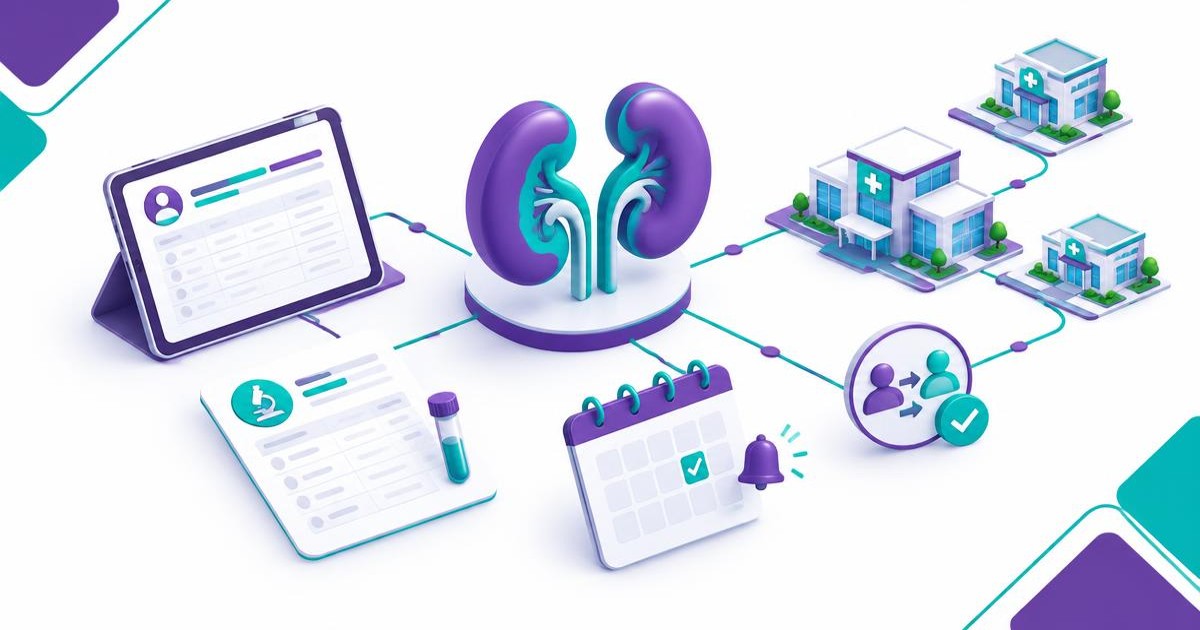
A pre-dialysis chronic kidney disease follow-up program for a Saudi hospital is a structured recall process. It identifies patients whose kidney function is declining, books them into scheduled nephrology and multidisciplinary review, and prepares them for a planned rather than emergency start to dialysis. Its purpose is fewer unplanned starts and better-informed patients.
Key takeaways
- A pre-dialysis program is a registry, a recall schedule, a multidisciplinary review routine and a dialysis-readiness pathway. It is an operating model, not a new building.
- Saudi evidence points to a gap in the months before dialysis: early CKD is often silent, and a 2025 Saudi study programme found emergency dialysis starts linked to late nephrology care and low patient engagement.
- Start with data your hospital already holds: eGFR, urine albumin, and diabetes and hypertension diagnoses.
- Measure operational reliability first (recall adherence, lab completeness, referral lead time). Clinical-outcome definitions need expert sign-off. HOLD — expert review
On this page
Why the months before dialysis need their own program
Most hospital kidney services are organised around two moments: the nephrology outpatient visit and the dialysis session. The stretch between them, when estimated glomerular filtration rate (eGFR) is falling but the patient feels well, is where programs tend to be thinnest.
The scale of the downstream burden is not small. A 2023 preprint adapting Saudi CKD guidelines, produced under the Ministry of Health and Health Holding Company, states that kidney disease is the third leading cause of death in the Kingdom, and cites Saudi Center for Organ Transplantation estimates of 21,496 dialysis patients in 2020, 92% of them on haemodialysis (preprint, not peer reviewed; verify before external citation). In primary care terms, the picture is quieter: a 2026 JMIR Public Health and Surveillance survey of 14,239 participants reported 3.5% self-reported renal disease (a figure that includes kidney stones), and notes that kidney disease in its early stages is often asymptomatic.
Silence is the operational problem. Patients without symptoms skip labs, miss follow-up and arrive in an emergency department with advanced disease. A 2025 doctoral dissertation drawing on Saudi patients (University of North Carolina at Chapel Hill, deposited in the Saudi Digital Library) found that most of 128 surveyed patients with advanced CKD scored at the lowest engagement level, and that 18 patients interviewed described individual, social and health-system factors behind unplanned dialysis starts. The author calls for structured pre-dialysis programs that include education, self-management support and patient activation. These are small samples and one dissertation, so treat them as a direction, not a verdict.
What Saudi public services already show
A useful reference point is the Eastern Region Health Cluster's CKD clinic at Al-Nasirah Healthcare Center in Al-Qatif, announced by the Ministry of Health in September 2021 as part of the new healthcare model. The announcement describes a CKD follow-up track at primary healthcare centres, referral via the Mawid app, and eligibility examples such as stage 3 disease, albuminuria above 30 mg/g and a family history of kidney failure, plus return of patients to the centre's clinic after hospital treatment.
Three design lessons carry over to hospitals: define who qualifies, define how referral happens, and define how patients return to routine follow-up. Many hospital groups have one or two of these and not all three.
On screening, the evidence base is mixed. The 2023 guideline preprint notes that a 2019 KDIGO conference found no agreement on whether health systems should prioritise population-wide CKD detection. A 2025 Saudi Medical Journal study of 215 people in Riyadh used point-of-care eGFR testing during a World Kidney Day campaign and found lower eGFR associated with older age, overweight or obesity, hypertension or diabetes. The practical reading for a hospital: you do not need to screen the public. Start with patients already in your system who carry those risk factors.
The five building blocks of a pre-dialysis program
1. Build the at-risk registry from data you already have
Define entry rules with your nephrology lead, for example: eGFR below a clinician-set threshold on repeat tests, albuminuria above a set level, or diabetes or hypertension with no recent kidney panel. Pull from laboratory, diagnosis and pharmacy records across branches. In multi-branch groups the hard part is a single patient identity across sites, which is where national interoperability work matters (see our guide to NHIC interoperability for multi-branch hospitals). Entry thresholds are a clinical decision. HOLD — expert review
2. Set recall intervals by risk, not by habit
A registry only helps if each patient has a next-due date. Ask nephrology to define risk tiers and the review and lab interval for each, then let the system generate due lists and reminders. The intervals themselves come from your clinical guidelines (KDIGO and the Saudi guideline work are typical references), not from software. HOLD — expert review
3. Schedule multidisciplinary touchpoints, not just physician visits
The dissertation's recommendation points to multidisciplinary teams. In practice that usually means a nephrologist, a clinical pharmacist who reviews medicines that affect the kidneys, a dietitian, and a nurse educator. Group these into one visit day where the hospital layout allows, so a patient with a long commute attends once instead of three times.
4. Engage the patient in Arabic and English, and bring the caregiver in
Reminders for labs and visits, short education modules and a way to report symptoms or ask a nurse a question all belong here. Many dialysis decisions are made with family. Allow a caregiver to receive reminders where the patient consents. Keep content bilingual and written for general readers.
5. Add a dialysis-readiness pathway
For patients approaching kidney failure, the program should switch from monitoring to preparation: modality education (haemodialysis, peritoneal dialysis, conservative care), transplant referral conversations, and the timing of vascular access planning. These are clinical decisions. The operational job is to make sure each step has an owner, a due date and a record. HOLD — expert review
An illustrative scenario (hypothetical)
Consider a three-hospital group in one region with one nephrology clinic. Today, kidney panels sit in three laboratory systems and the nephrology clinic sees patients who are referred late. The group builds a registry of patients with diabetes or hypertension and a rising creatinine or albuminuria result, assigns each a risk tier set by the nephrologist, and generates a weekly due list per branch. Pharmacists review the medicine lists of patients in higher tiers. A nurse educator calls patients who miss a lab. After two quarters, the group reviews how many registry patients have a current eGFR and urine albumin on file, and how long referrals take from first abnormal result to nephrology appointment. This scenario is an example of workflow design, not a reported result.
Metrics worth tracking
Begin with operational measures that the hospital controls:
- Share of registry patients with eGFR and urine albumin recorded in the last 12 months.
- Recall adherence: scheduled reviews attended versus due.
- Referral lead time from first qualifying abnormal result to nephrology appointment.
- Share of dialysis starts that follow a documented readiness plan.
Outcome measures such as progression rates, hospitalisation or mortality need definitions, risk adjustment and clinical governance before they are reported. HOLD — expert review
Governance: privacy, residency and device status
Kidney data are sensitive health data. Map consent, access roles, retention and cross-border processing to the Personal Data Protection Law and your hospital's policies, and confirm cloud hosting and data-residency arrangements with your vendor. [VERIFY WITH BRAND] If any software function is intended for diagnosis or clinical decision support, check with the Saudi Food and Drug Authority whether it falls under medical device rules. [VERIFY WITH BRAND] Our related guide on PDPL-compliant patient support programs covers consent design.
Where a platform like CareSync fits
A multi-branch group needs one patient view, configurable recall rules, bilingual patient messaging, and reporting that separates operational from clinical measures. CareSync Network is designed for multi-branch hospital operations; which of these functions are available in a given deployment, and how they connect to your laboratory and EHR systems, should be confirmed with the CareSync team. [VERIFY WITH BRAND]
FAQ
What is a pre-dialysis CKD follow-up program?
It is a hospital-run process that tracks patients with declining kidney function, schedules their nephrology and multidisciplinary reviews, and prepares them for a planned start to dialysis or other kidney-replacement choices.
How often should patients with CKD be reviewed?
The interval depends on the patient's stage, albuminuria level and risk, and should be set by the nephrology team using current guidelines. A program's role is to make sure each patient has a next-due date and that it is kept. HOLD — expert review
Can a hospital group run this across several branches?
Yes, if branches can share a single patient identity and laboratory results. A registry, risk tiers and a shared recall list are the minimum. Integration effort depends on your existing systems.
What data do we need to start?
Repeat eGFR and urine albumin results, diabetes and hypertension diagnoses, current medicines, and appointment history. Many hospitals already hold these but in separate systems.
Does this software need SFDA approval?
It depends on the intended use of each function. Scheduling and reminders are different from diagnosis or treatment decisions. Confirm classification with SFDA and your vendor. [VERIFY WITH BRAND]
Sources
- Ministry of Health, Saudi Arabia: Al-Qatif CKD clinic launched at Al-Nasirah Healthcare Center (7 September 2021)
- JMIR Public Health and Surveillance 2026;12:e81849, renal disease prevalence in Saudi primary care
- Adapting CKD clinical practice guidelines for the Saudi context (GRADE-ADOLOPMENT), Preprints.org, 2023 (preprint)
- Saudi Medical Journal 2025;46(12), community-based kidney disease screening in Riyadh
- Alfahad A. Person-centered kidney care and transition to dialysis: an investigation from Saudi Arabia. University of North Carolina at Chapel Hill, 2025, via Saudi Digital Library