Nafath Integration for Hospital Patient Apps in Saudi Arabia: Identity, Consent and Duplicate Records
Short answer: Nafath integration for a hospital patient app means letting patients verify who they are through Saudi Arabia's national authentication app instead of a hospital-specific password. Done well, it speeds registration, strengthens consent and e-forms, and reduces duplicate records across branches. The hospital still decides which actions need which level of verification.
Clinical outcome note: any claim that identity verification improves clinical outcomes or safety is HOLD — expert review.
Key takeaways
- Nafath is the national authentication app run by the National Information Center (NIC), the operational arm of SDAIA. A 2024 OECD OPSI case study reports more than 470 integrated platforms and 17.2 million downloads (self-reported). [VERIFY WITH BRAND: current figures]
- Access rules for private healthcare providers, onboarding steps and any fees must be confirmed with NIC before design. [VERIFY WITH BRAND]
- Use stronger verification for sensitive actions (records, consent, prescriptions) and lighter steps for browsing.
- A national identity as the patient key reduces duplicate medical record numbers across branches.
On this page
What Nafath is, and why hospitals care
The OECD Observatory of Public Sector Innovation's case study on the Nafath app (published 29 June 2024) describes it as a mobile authentication app that uses the phone camera and AI-based biometrics, including face and fingerprint recognition, to verify identity. It states that the project is mandated to NIC, the operational arm of SDAIA, was launched in 2021, has three authentication levels shaped by service sensitivity classified with the National Cybersecurity Authority, and reports more than 17.2 million downloads, more than 470 integrated government and private platforms and apps, and over 380 million verification requests with an average completion time of 20 seconds. These figures are self-reported by the case study and were not independently verified. For hospitals, the practical meaning is that most adult patients already hold a verified digital identity on their phone.
Where identity friction costs hospitals money
Four recurring problems: first-time registration at reception that duplicates data entry; separate logins per branch app or portal; paper consent forms that are hard to audit; and duplicate medical record numbers when the same patient registers at two branches with different spellings of an Arabic name. Each costs staff time and creates data quality risk. See /blog/hospital-operations-efficiency-unified-platform-ksa and /blog/multi-branch-hospital-patient-app-saudi-arabia where available.
Five places Nafath can fit in a patient app journey
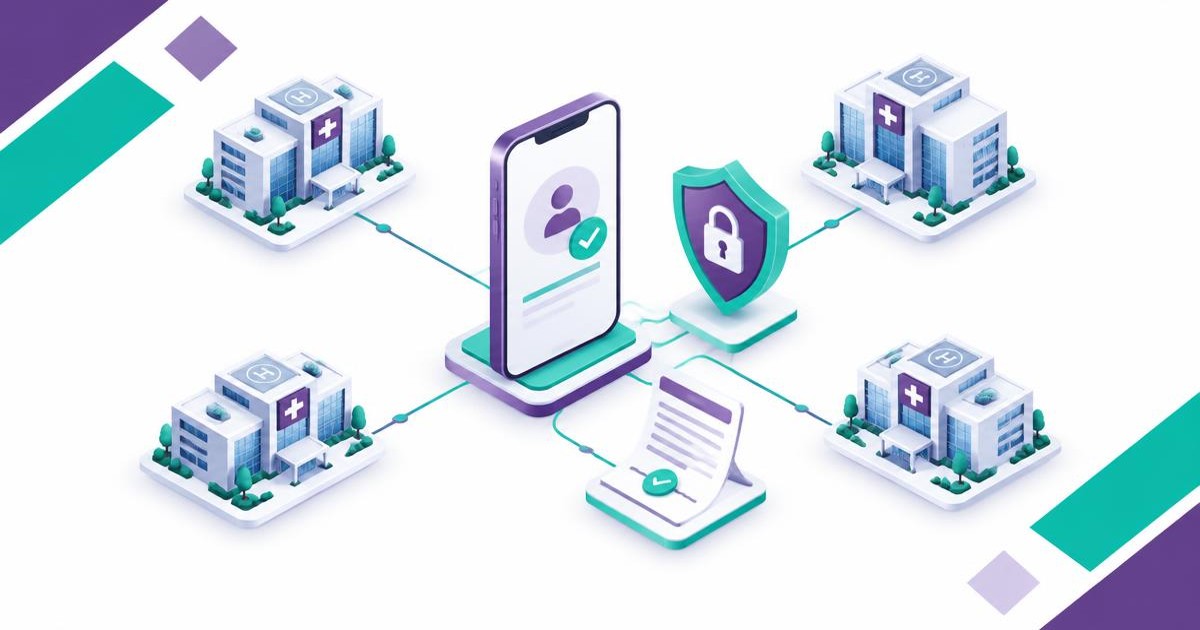
- Registration: verify identity once and prefill name and national ID fields from the verified response, subject to what the integration returns. [VERIFY WITH BRAND]
- Login: replace passwords with Nafath approval for returning users, with a fallback for non-Saudi residents and visitors who cannot use it.
- Consent: capture an authenticated, timestamped consent for treatment, data sharing or a patient support programme.
- Sensitive actions: viewing results, requesting records, or changing contact details need step-up verification.
- Family access: guardians acting for children or dependents require a separate, documented process; do not assume Nafath alone covers delegated access. [VERIFY WITH BRAND]
Nafath login for a hospital patient portal: design rules
Offer a clear alternative path for patients who cannot use Nafath. Match authentication level to the sensitivity of the action. Never store more identity data than the use case needs. Log each verification for audit. Test with real patients, including older adults, because the second-device step can confuse some users.
Duplicate records: the multi-branch benefit
When national identity is the matching key, a patient who registers at the Jeddah branch and later visits the Riyadh branch can be matched to the same master patient index with higher confidence. This does not remove the need for matching rules for newborns, visitors and residents without a verified identity, nor for clinical review of merges. Hospital data teams should keep a manual review queue. Related: /blog/nhic-interoperability-multi-branch-hospitals-saudi-arabia.
PDPL and consent considerations
Identity data and health data are personal data under the Personal Data Protection Law. Collect only what is needed, state the purpose, and keep identity verification logs separate from clinical content. Whether the hospital or the platform is the controller, and what hosting is required, are legal questions to settle before launch. [VERIFY WITH BRAND: PDPL roles, SDAIA regulations, hosting claims.] See /blog/pdpl-data-localisation-health-saas-saudi-hospitals.
A worked scenario: a four-branch hospital group
A group runs separate patient portals in each branch, with different logins and four patient numbering schemes. It launches one patient app with Nafath verification at first registration and for sensitive actions. Registration staff see verified identity, records are matched to a single master index, and consent for a pharmacy refill reminder programme is captured digitally with a timestamp. Staff keep a manual queue for unmatched records. The scenario is illustrative and does not describe a CareSync customer result.
Rollout plan
Weeks 1–2: confirm Nafath access and onboarding requirements, and map which actions need which verification level. Weeks 3–6: design registration, login and consent flows; build the fallback path; legal review. Weeks 7–10: pilot at one branch with reception trained to help patients. Weeks 11–12: review failed verifications, duplicates caught, and registration time, then extend to other branches. Track your own baselines; do not assume benchmark figures.
Vendor questions
Does the platform support Nafath integration for private providers, or only through your own build? Which authentication level is used for each action? How are non-Saudi residents handled? Can it write to your master patient index and EHR? How are verification logs retained? What is the fallback when Nafath is unavailable? [VERIFY WITH BRAND: CareSync Network capabilities.]
FAQ
Can a private hospital use Nafath for patient login?
Nafath is described as accepting integration from government and private platforms, but eligibility, onboarding and fees for healthcare providers must be confirmed with the National Information Center. [VERIFY WITH BRAND]
Does Nafath replace the hospital's patient ID?
No. It verifies identity; the hospital still needs its own medical record number and matching rules, especially for newborns, visitors and non-Saudi patients.
What about patients who cannot use Nafath?
Provide a fallback verification path at reception or through another approved method, so access is not limited to Nafath users.
Does Nafath handle consent?
It can strengthen the proof of who gave consent. The consent wording, purpose and storage remain the hospital's responsibility under PDPL. [VERIFY WITH BRAND]
How long does integration take?
A focused pilot can be planned in roughly 12 weeks, mostly spent on approvals, flows and training. This is a planning estimate, not a benchmark.
Sources
- OECD Observatory of Public Sector Innovation, "Nafath App" case study, published 29 June 2024. Figures are self-reported by the case study.