Rare Disease Patient Registry Platform for Saudi Hospitals: From Spreadsheet to Support Programme
Short answer: A rare disease patient registry platform for Saudi hospitals is a consented, shared record of diagnosed patients that also drives follow-up, referral and treatment-access workflows. Built on one platform, it lets hospitals track patients across branches and lets pharma sponsors run a compliant support programme without duplicating data collection.
Clinical outcome note: any statement that a registry or support programme improves diagnosis, adherence or clinical outcomes is HOLD — expert review.
Key takeaways
- Saudi stakeholders ranked comprehensive patient registries as their top priority for rare disease and orphan drug policy (Frontiers in Pharmacology, 2025).
- A registry that only stores data fails; one that triggers follow-up, referral and access tasks gets used.
- Consent, purpose limitation and data residency under PDPL must be designed in from the first enrolment screen.
- Hospital registry and pharma support programme should share one consented patient record, with separate access rules.
On this page
Why registries are the gap in Saudi rare disease care
A multi-stakeholder workshop held in Riyadh in June 2023 and published in Frontiers in Pharmacology in May 2025 (Abozaid et al.) brought together 59 stakeholders. The authors report that, without registry data, tracking patients and estimating prevalence is difficult, and participants voted comprehensive patient registries as the top priority, ahead of a national rare disease strategy and early detection. The same paper notes that a national Birth Deficit Registry has been in development since 2015, with progress stalled by funding limits, and that administrative burden and privacy concerns are obstacles to registry creation.
For a hospital, the practical consequence is familiar: the metabolic physician keeps one spreadsheet, the genetics clinic another, and the neuromuscular team a third. Nobody can answer a simple question such as "how many confirmed patients do we follow, and how many missed their last review?"
What a rare disease registry platform must do (beyond storing records)
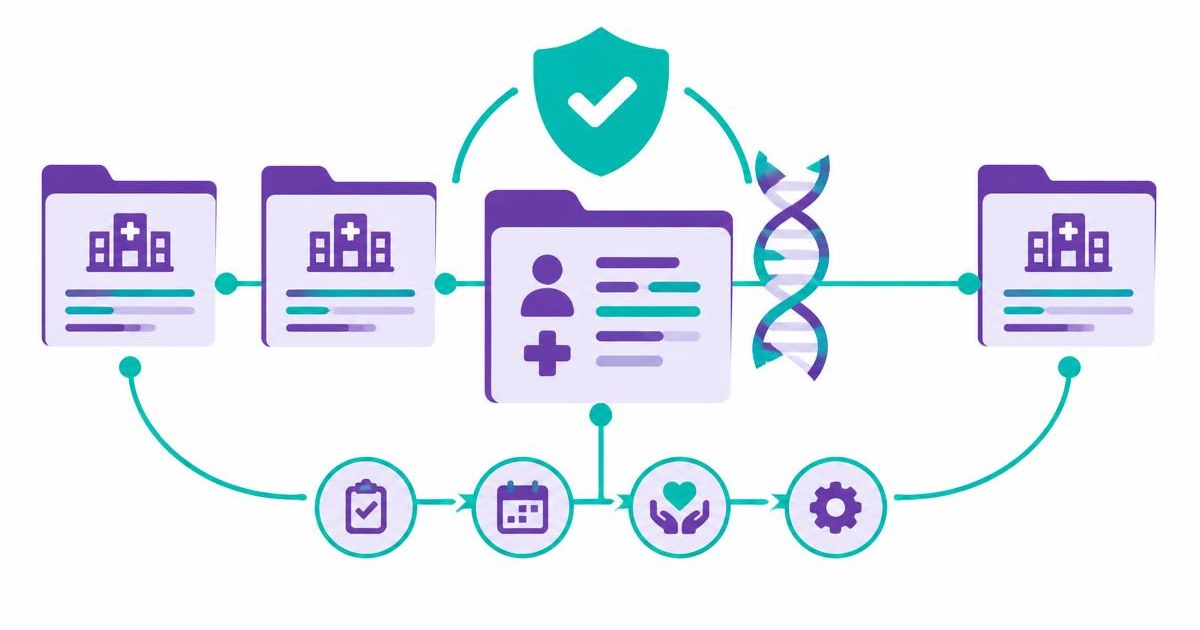
Treat the registry as an operating system for the patient journey, not an archive. A usable platform covers five jobs:
- Structured enrolment with diagnosis, genetic confirmation status, treating centre and explicit consent.
- Follow-up scheduling by disease protocol, with missed-visit alerts to the coordinator.
- Referral tracking between the diagnosing centre and the treating centre, so patients are not lost between branches.
- Treatment-access tasks, such as documentation for prior approvals, so coordinators see what is blocking therapy.
- Reporting that a medical director can trust: counts by diagnosis, region and follow-up status.
Rare disease patient registry software Saudi Arabia: the build-versus-configure question
Many centres start with a custom database. The cost appears later in maintenance, Arabic and English interfaces, role-based access and audit trails. A configurable, white-label platform shifts effort to protocol design, which is where clinical teams add value. [VERIFY WITH BRAND: CareSync PSP Connect and CareSync Network configuration options for registry-style workflows.]
Designing consent and data protection (PDPL) from day one
A registry holds health and genetic information, which is sensitive personal data. Design choices that reduce risk: collect only fields tied to a stated purpose; record consent separately for care coordination, registry research and any pharma programme contact; give patients a way to withdraw; and keep access role-based with audit logs. Data residency and cross-border transfer rules need legal review before any sponsor receives data. [VERIFY WITH BRAND: PDPL, SDAIA implementing regulations and hosting claims.] See our guide to PDPL-compliant patient support programmes: /blog/pdpl-compliant-pharma-patient-support-programs-ksa.
Where a pharma patient support programme fits
A registry and a patient support programme (PSP) serve different owners. The hospital owns the clinical record. A pharma sponsor may fund support services such as nurse education, reminders and adherence check-ins, but should only receive what the patient has consented to share. On a shared platform, the same patient identity supports both, with separate permissions and a clear consent trail. This avoids asking a family with a rare-disease child to repeat the same forms for each stakeholder. For the pharma side, see /blog/digital-psp-platform-pharma-saudi-arabia.
A worked scenario: a three-branch hospital group
Consider a group with a central genetics clinic in Riyadh and treating branches in two other regions. A child is diagnosed after newborn screening. Without a registry, the family's follow-up depends on a paper letter. With a shared registry: the diagnosing clinician enrols the child with parental consent; the platform creates a follow-up schedule for the treating branch; the coordinator sees a missed-visit alert after the review date passes; and the family receives reminders in Arabic. The scenario is illustrative and does not describe a specific CareSync customer outcome.
Implementation roadmap: first 90 days
Weeks 1–3: pick two to three diseases and agree the minimum data set with clinical leads. Weeks 4–6: configure enrolment, consent and follow-up protocols; review with legal and the data protection officer. Weeks 7–10: pilot with one centre and one coordinator; track missed visits and referral delays. Weeks 11–13: review the data quality, add diseases, and decide whether a sponsor-funded support programme is appropriate.
What to ask a vendor before you sign
Can consent be captured per purpose and withdrawn? Can access be restricted by role and centre? Is Arabic a first-class interface or a translation layer? Can the platform export data in formats your analysts and regulators can use? How is hosting handled for Saudi patient data? Who can see de-identified versus identifiable records? How are audit logs retained?
FAQ
What is a rare disease patient registry platform?
It is a consented, structured record of diagnosed patients that also supports follow-up, referral and treatment-access workflows. Unlike a static database, it tells coordinators who needs action next.
Is there a national rare disease registry in Saudi Arabia?
A 2025 policy paper reports that a national Birth Deficit Registry has been in development since 2015, with progress stalled by funding limits. Check the current status with the Ministry of Health. [VERIFY WITH BRAND]
Can a hospital share registry data with a pharma company?
Only within the consent given by the patient and the limits of PDPL and applicable regulations. Keep the clinical registry and any sponsor programme under separate permissions. [VERIFY WITH BRAND]
How long does it take to launch a registry?
A focused pilot covering two or three diseases at one centre can be planned in roughly 90 days, depending on governance approvals. This is a planning estimate, not a benchmark.
Do we need a separate platform for a patient support programme?
Not necessarily. A shared platform can serve both, if consent, access rules and reporting are separated by purpose.