Home Healthcare in Saudi Arabia: How Digital Coordination Keeps Patients, Families and Care Teams Connected
How hospitals coordinate home visits, families and escalation digitally in Saudi Arabia.
Key takeaways
- The Saudi Ministry of Health operates 244 home healthcare departments with over 2,700 specialised staff, managing more than 58,000 active cases annually.
- Home healthcare services in Saudi Arabia include wound care, chronic disease management, post-operative care, oral health, and intravenous therapy.
- Access to the publicly funded national home healthcare programme requires a referral from specialised hospital departments or primary healthcare centers based on eligibility.
Reviewed by the CareSync Medical Team · Last reviewed
On this page
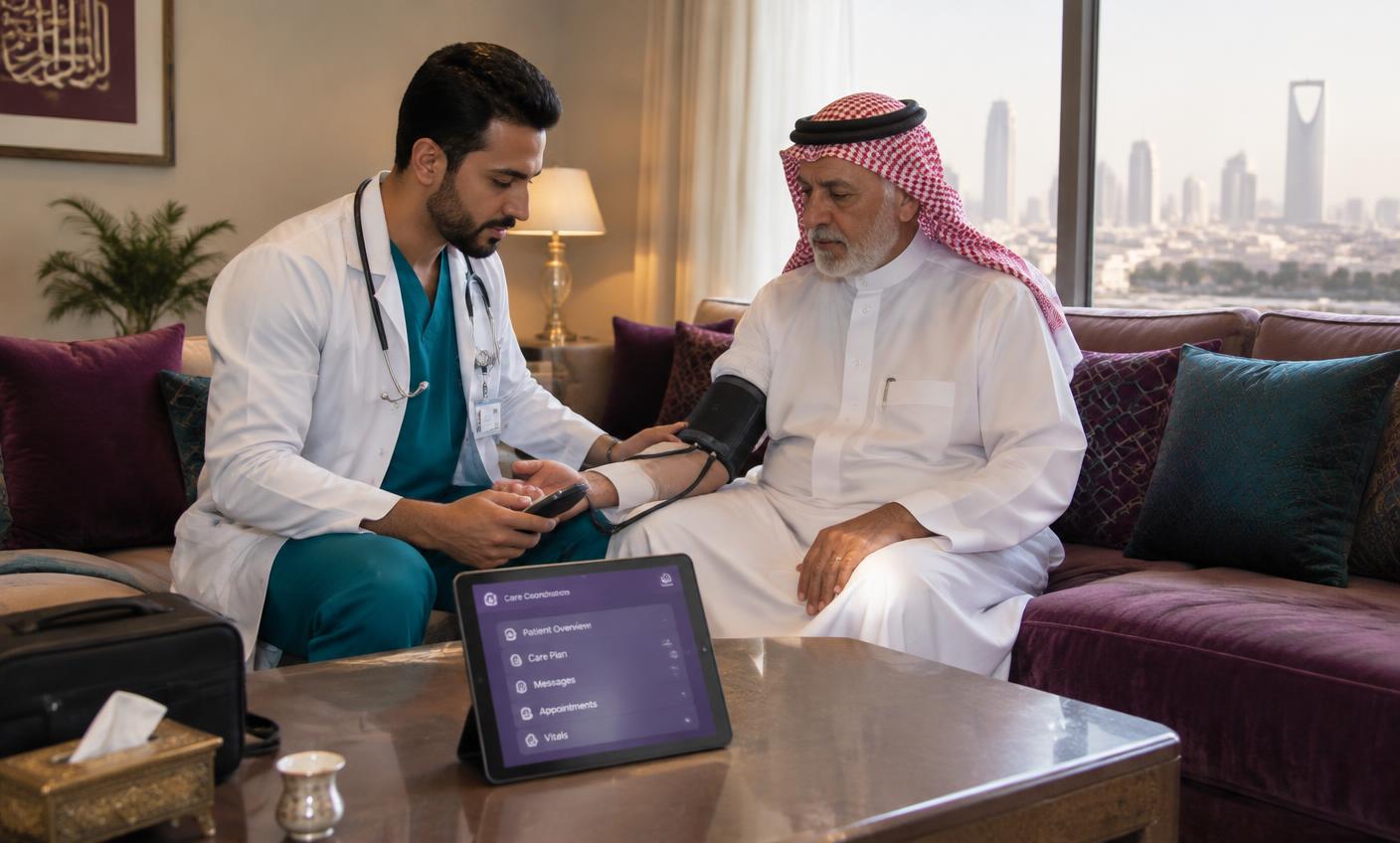
Home healthcare brings clinical care to patients in their own homes: wound care, chronic disease follow-up, post-operative care, intravenous therapy and more. In Saudi Arabia it is a growing part of the care continuum, especially for older adults and people with chronic conditions. The clinical teams are the foundation, but the programme only works when scheduling, communication, supplies and escalation are coordinated. That coordination layer is where digital tools help most.
Key takeaways
- The national programme is substantial. The Ministry of Health reports 244 home healthcare departments with more than 2,700 specialised staff, more than 58,000 active cases in a year and more than 71,000 total beneficiaries since launch.
- Services are broad. They include wound and bed-sore treatment, chronic disease follow-up, home visits, post-operative care, oral and dental health and intravenous therapy.
- Access is referral-based. Services can be requested through specialised hospital departments or primary healthcare referrals when eligibility criteria are met.
- Teams are multidisciplinary. A 2017 report described visiting teams of a physician, two nurses, a physiotherapist, a dietitian and social workers.
- Coordination is the bottleneck. Visits, families, supplies and records need to stay aligned across many people and many homes.
How large is home healthcare in Saudi Arabia?
| Indicator | Figure | Source |
|---|---|---|
| Home healthcare departments | 244, with 2,700+ specialised staff | Arab News, citing the Ministry of Health, Jan 2025 |
| Active cases in a year | 58,000+ | Same |
| Total beneficiaries since launch | 71,000+ | Same |
| Programme start | 2009, publicly funded, run by regional health authorities | Geriatrics journal study |
| Example regional volume | 22,701 visits to 1,141 enrolled patients in Al-Ahsa in a year | Ministry of Health news |
| Example regional volume | 34,210 visits to 1,958 patients in Jazan in six months | Ministry of Health news |
Regional examples show many visits per patient, which means coordination effort scales with every enrolled patient.
What makes home healthcare hard to coordinate?
| Challenge | What happens | What good coordination looks like |
|---|---|---|
| Scheduling and routing | Visits cancelled, rescheduled or missed across many addresses | One shared schedule, reminders to family and a clear reschedule route |
| Family communication | Families unsure when the team is coming or who to call | A single channel for updates, questions and visit summaries in Arabic |
| Between-visit changes | Problems appear days before the next visit | Simple check-ins and an escalation path to the team |
| Supplies and equipment | Dressings, devices or medicines run short | Visible supply requests tied to the care plan |
| Documentation | Records scattered across paper, phones and systems | Visit notes captured once and visible to the right clinicians |
| Hospital link | Home teams and the discharging hospital lose touch | Shared status and follow-up flags with the hospital |
What should a digital coordination layer cover?
| Function | Purpose |
|---|---|
| Patient and family app | Visit times, reminders, secure messaging, simple symptom or readings check-ins |
| Team scheduling | Visit allocation, rescheduling and visible workload |
| Escalation | Defined triggers that alert a nurse or physician |
| Care plan and tasks | Shared tasks such as dressing changes and medication reviews |
| Reporting | Visit completion, cancellations and follow-up status by site or team |
| Consent and privacy | PDPL-aligned consent, role-based access and audit trail |
A five-step plan for providers
- Map the journey. From referral to discharge from the programme, list every handoff between hospital, home team and family.
- Choose one cohort. Start with a defined group, such as chronic wound care or post-operative patients.
- Give families one channel. Use a single Arabic-first channel for reminders and questions.
- Define escalation and ownership. Decide who responds, how fast and what is documented.
- Review monthly. Track completed visits, cancellations, escalations and family feedback, then refine.
How CareSync helps
CareSync is a white-label health-tech ecosystem built in Riyadh. CareSync Network and CareSync Clinic are designed to give hospitals and clinic groups a branded channel for visit reminders, family communication, check-ins and escalation around home care, in Arabic and English. CareSync does not deliver clinical care, and clinical protocols stay with the treating teams.
Frequently asked questions
What is home healthcare in Saudi Arabia? Clinical and nursing care delivered at the patient's home. The Ministry of Health has run a publicly funded programme through regional health authorities since 2009.
Who is eligible for the Ministry of Health home healthcare programme? Eligibility criteria apply, and services are requested through specialised hospital departments or primary healthcare referral. Check criteria with your regional health cluster.
What services are included? Wound and bed-sore treatment, chronic disease follow-up, home visits, post-operative care, oral and dental health and intravenous therapy, among others.
How can hospitals reduce missed home visits? Share one schedule, send reminders to families and make rescheduling easy, then monitor cancellations by cause.
Can remote monitoring be combined with home visits? Yes. Remote readings can help teams decide who needs a visit sooner, while visits remain essential for hands-on care.
How do families stay informed? Through a single channel for visit times, summaries and questions, designed in Arabic first and accessible to caregivers.
How is patient data protected in home care? Health data is sensitive under the PDPL, so use consent, role-based access and secure hosting, and avoid ad hoc messaging tools for clinical information.
What should providers measure? Visits completed against planned, cancellations and reasons, escalations and response times, supply delays and family satisfaction.
Home care works when everyone is in the loop
Saudi Arabia's home healthcare programme already reaches tens of thousands of patients. Providers who give families, nurses and hospital teams one shared view can extend that reach safely.
Planning a home care programme? Book a CareSync demo at CareSync.
About CareSync
Prepared by the CareSync Medical Team. This article is educational, not medical advice or a substitute for clinical, legal or regulatory review. Research findings are source-specific, not measured CareSync outcomes.
Sources
- Arab News. Ministry expands Saudi Arabia's home healthcare services, 1 January 2025.
- Arab News. Saudi health care program carries out 31,152 visits in 2017, 2017.
- Ministry of Health. Al-Ahsa: 22,000+ home medical visits, 2022.
- Ministry of Health. Jazan: 34,000+ home medical visits in 6 months, 2021.
- Geriatrics. Home healthcare and mortality among older adults in Saudi Arabia.