Connecting Hospital Patient Apps to HIS and EHR Systems
How hospital patient apps integrate with existing HIS and EHR systems in Saudi Arabia: integration patterns, common pitfalls, a vendor evaluation checklist.
Key takeaways
- Integrating patient apps with existing HIS and EHR systems should be scoped and tested before setting a launch date to avoid costly project delays.
- Appointment scheduling is the recommended first integration because it delivers immediate patient value and tests both read and write data paths.
- A technical proof-of-concept using live or sandboxed data is essential to accurately evaluate vendor integration capabilities and legacy API maturity.
Reviewed by the CareSync Medical Team · Last reviewed
On this page
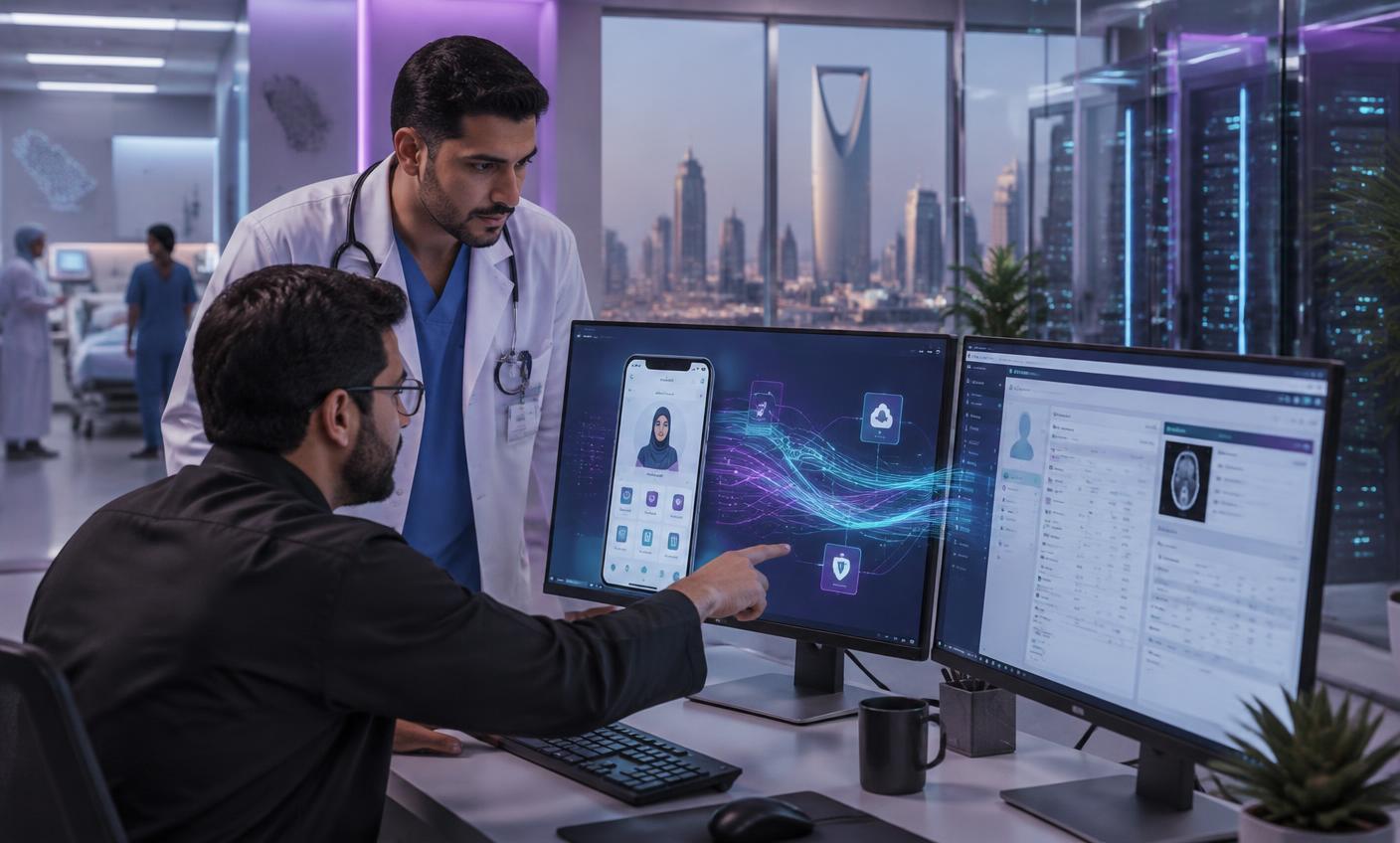
A patient app's integration layer — not its front-end design — is what determines whether appointment booking, lab results, and records actually work for patients in real time. Integration with your hospital's existing HIS and EHR systems should be scoped and tested before a launch date is set, because retrofitting integration onto an app that was designed and built without it is consistently harder than designing for it from the start.
Why integration is where most patient app projects stall
A patient app with polished UI but no live connection to the HIS behind it shows patients outdated appointment slots, static lab results, and records that don't reflect their actual visit history. Hospitals that treat integration as a later phase — "launch the app, connect systems after" — routinely find the connection work takes longer and costs more than expected, because legacy HIS and EHR systems in Saudi Arabia vary widely in API maturity and documentation quality.
Common integration patterns
| Patient app function | Connects to | What it requires |
|---|---|---|
| Appointment booking | Scheduling / HIS module | Real-time slot availability and booking write-back |
| Lab and radiology results | LIS/RIS | Secure, patient-matched results delivery |
| Medical records access | EHR | Read access scoped to the authenticated patient |
| Billing and insurance | ERP / billing system | Balance and claim status visibility |
| National health data exchange | NPHIES-aligned data flows | Workflows designed to align with national exchange standards, implemented alongside your hospital's own NPHIES connectivity — not a vendor compliance claim substituting for it |
Common integration pitfalls
- Assuming a vendor's "standard integration" covers your specific HIS vendor without confirming a prior, verified connection to that exact system
- Treating NPHIES alignment as a checkbox rather than an ongoing coordination point between the app vendor, your HIS vendor, and your own compliance team
- Underestimating how much legacy HIS systems vary in API documentation quality — some integrations are days of work, others are weeks
- Skipping a technical proof-of-concept with live (or sandboxed) data before committing to a full rollout timeline
A vendor evaluation checklist for integration capability
- Has the vendor integrated with your specific HIS/EHR vendor before — ask for a reference, not just a capability claim.
- Does the integration support real-time data (live appointment slots, current lab results), or batch-delayed data that lags behind actual hospital records?
- Who owns ongoing integration maintenance when your HIS vendor pushes an update — the app vendor, your IT team, or an undefined gap between them?
- Can the integration scope be tested with sandboxed data before committing to a go-live date?
FAQ
Does every HIS system require custom integration work? Most do, to some degree — even vendors with "standard connectors" typically need configuration specific to your HIS version and data model, so build integration time into the project timeline regardless of vendor claims.
Is NPHIES alignment the app vendor's responsibility or the hospital's? It's shared — the app's workflows should be designed to align with national exchange standards, but your hospital's own NPHIES connectivity and compliance processes remain your organization's responsibility.
How long does HIS/EHR integration typically add to a launch timeline? It varies widely by HIS vendor and API maturity — this is exactly why a technical proof-of-concept early in the project, rather than a generic estimate, is the only reliable way to scope it.
Frequently asked questions
Which integration should we build first?
Appointment scheduling. It delivers visible patient value quickly, exercises read and write paths, and reveals data-quality issues in your source systems before harder integrations begin.
Do we need FHIR to integrate a patient app?
FHIR R4 is the direction of national exchange in Saudi Arabia and a sensible default for new work, but many hospital systems still expose HL7 v2 messages or proprietary interfaces. A good integration layer speaks both and maps them to one model.
How do we keep patient data safe during integration?
Limit the app to the minimum data each feature needs, encrypt in transit and at rest, log access, and agree hosting and consent handling under the PDPL before any patient data flows.
Who maintains the integration after go-live?
Agree this in writing: which side monitors interfaces, how changes in the hospital system are communicated, and what response times apply when an interface fails.
How CareSync fits
CareSync Network is the white-label deployment of the CareSync platform for hospital groups in Saudi Arabia and the GCC: a branded patient app, teleconsultation, home-care coordination and integration with existing hospital systems, with scope and responsibilities agreed in writing for each deployment. We do not claim certifications we do not hold, and integration scope is validated with a technical proof-of-concept before timelines are committed.
Planning your next step? Talk to the CareSync team about your hospital group's rollout.
About CareSync
Prepared by the CareSync Medical Team. This article is educational, not medical advice or a substitute for clinical, legal or regulatory review. Research findings are source-specific, not measured CareSync outcomes.