Automating Post-Discharge Follow-Up Across Hospital Departments
How hospitals automate post-discharge follow-up: check-in triggers, readmission-risk flags, and department-level coordination, without manual call lists.
Key takeaways
- Automated post-discharge follow-up schedules check-ins by discharge type and department, routing symptom-flagged responses directly to clinical care teams.
- Automation does not replace nursing calls entirely; it handles routine outreach so clinicians can focus on flagged exceptions and timely interventions.
- Digital check-ins turn follow-up compliance into timestamped, reportable records across multiple hospital departments like cardiology, surgery, and pharmacy.
Reviewed by the CareSync Medical Team · Last reviewed
On this page
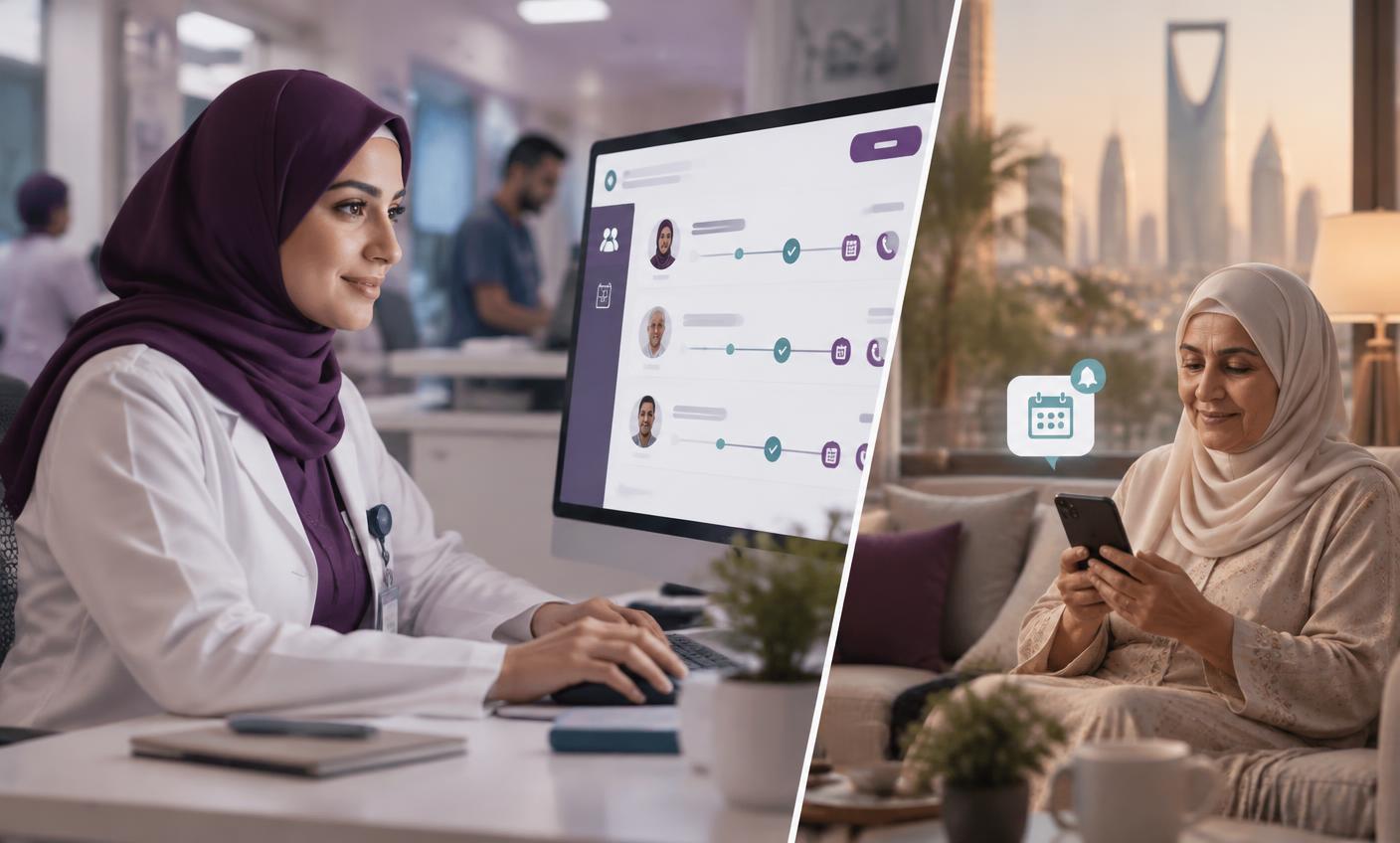
Automated post-discharge follow-up replaces manually maintained call lists with triggered check-ins — scheduled by discharge type and department, with symptom-flagged responses routed directly to the care team. The goal isn't to remove clinical judgment from follow-up, it's to make sure every discharged patient actually gets a timely check-in instead of relying on a nurse remembering to make a call between other duties.
The manual follow-up problem
Post-discharge follow-up often runs on a spreadsheet or paper call list maintained by whichever department discharged the patient, with no visibility for other departments that may also need to follow up on the same patient — physical therapy, pharmacy, or a specialist referral, for instance. Call lists get deprioritized during busy shifts, follow-up timing varies by whoever makes the call, and there's rarely a structured way to flag a concerning response for clinical review.
What automated post-discharge follow-up looks like
- Triggered check-ins by discharge type — a cardiac discharge and an outpatient procedure discharge warrant different follow-up timing and questions, configured once and applied consistently.
- Structured response capture — patients answer a short, clinically-designed check-in (symptoms, pain level, medication adherence) rather than an open-ended call that depends on what the caller thinks to ask.
- Symptom-flagged escalation — a concerning response routes immediately to the care team for review, rather than waiting for the next scheduled call.
- Cross-department visibility — if multiple departments need to follow up on the same patient, each sees the full picture rather than working from isolated, department-specific lists.
Cross-department coordination
| Department | Typical follow-up trigger | Escalation path |
|---|---|---|
| Cardiology | Scheduled check-ins at 48 hours, 7 days, 30 days post-discharge | Concerning vitals or symptom report → cardiology care team |
| Surgery | Wound-care and pain check-ins on a condition-specific schedule | Infection signs or uncontrolled pain → surgical team |
| Pharmacy | Medication adherence check-in after first refill window | Non-adherence or side-effect report → pharmacist review |
| Physical therapy | Mobility and exercise-compliance check-in | Missed sessions or pain escalation → PT care team |
Impact on readmission risk and patient experience
Structured, triggered follow-up is designed to catch a deteriorating condition earlier than an unstructured call — but the actual reduction in readmissions depends heavily on patient population, discharge type, and how well the care team acts on flagged responses, so any specific percentage claimed by a vendor should be treated as an estimate, not a guarantee. What can be said with more confidence is operational: consistent follow-up timing, structured data instead of call notes, and a documented audit trail for every discharged patient.
FAQ
Does automated follow-up replace nurse phone calls entirely? No — it structures when check-ins happen and flags concerning responses for a human to act on; a flagged patient still gets a clinical phone call or visit, just triggered reliably rather than left to memory.
Can follow-up schedules differ by discharge type? Yes, and they should — a cardiac discharge, a surgical discharge, and a routine outpatient procedure warrant different check-in timing and questions, configured once per discharge type.
How does this help hospitals measure follow-up compliance? Every triggered check-in and response becomes a timestamped record, which turns "did we follow up with every discharged patient" from a manual audit into a reportable metric.
Frequently asked questions
Which patients should automated follow-up cover first?
Start with cohorts where follow-up is structured and high-volume: surgical day cases, chronic disease reviews and medication changes. Maternity and elderly patients often benefit early because their pathways are well defined.
Does automation replace nursing calls?
No. Automation handles routine check-ins, reminders and education; nurses handle the exceptions the pathway surfaces. The goal is to focus clinical time where judgement is needed, not to remove it.
How do we measure whether follow-up automation works?
Track contact completion rates, response rates to digital check-ins, escalation volumes and time-to-callback, alongside readmission and attendance trends. Define the baseline before you switch anything on.
What consent do we need for automated messages?
Obtain explicit consent for health-related communication under the PDPL, record channel preferences, and make opting out simple at any time.
How CareSync fits
CareSync Network is the white-label deployment of the CareSync platform for hospital groups in Saudi Arabia and the GCC: a branded patient app, teleconsultation, home-care coordination and integration with existing hospital systems, with scope and responsibilities agreed in writing for each deployment. We do not claim certifications we do not hold, and integration scope is validated with a technical proof-of-concept before timelines are committed.
Planning your next step? Talk to the CareSync team about your hospital group's rollout.
About CareSync
Prepared by the CareSync Medical Team. This article is educational, not medical advice or a substitute for clinical, legal or regulatory review. Research findings are source-specific, not measured CareSync outcomes.