Hybrid Antenatal and Postnatal Follow-Up in Saudi Hospitals: Where Virtual Visits Fit
Short answer: A hybrid antenatal and postnatal follow-up platform lets a Saudi hospital schedule low-risk pregnancy and postpartum contacts as a mix of in-person and virtual visits, send reminders, and flag women who need clinical review. Examinations, labs and ultrasounds stay in person. The platform handles scheduling, tracking and escalation; clinicians decide the care plan.
Clinical outcome note: any statement that hybrid follow-up improves maternal or infant outcomes, or reduces complications or visits safely, is HOLD — expert review.
Key takeaways
- A 2023 Cureus paper proposes a model for Saudi primary care with four in-person and four virtual antenatal visits plus two postpartum visits, starting as a one-site pilot. It is a proposal, not outcome evidence.
- Telehealth in this model covers education, complaints, fetal movement, breastfeeding, mental health screening, and blood pressure and glucose readings; examinations, labs, ultrasound and high-risk referral stay in person.
- Postnatal follow-up is often the weaker link: the paper notes no official postnatal clinic existed at its study centre.
- Start with low-risk pregnancies, a defined escalation rule, and a pilot at one site. [HOLD — expert review: clinical protocol]
On this page
The gap: the visit schedule is clinical, the logistics are not
Razaz Wali's 2023 paper in Cureus (vol. 15, e47295) proposes integrating virtual clinics into antenatal and postnatal care at primary healthcare clinics of the Ministry of National Guard Health Affairs, for low-risk pregnancies. It cites WHO data that a healthcare worker attends 99.4% of pregnancies in Saudi Arabia and notes that WHO recommends at least four visits for low-risk pregnancies, at 12, 20, 28 and 36 weeks. In other words, access to a birth attendant is rarely the problem. The operational problems are scheduling, remembering, and noticing when a woman has not been seen. This article takes the paper's structure as a starting point for hospital operations. It is not a clinical protocol, and each hospital's obstetric leadership must set its own.
What the proposed model looks like
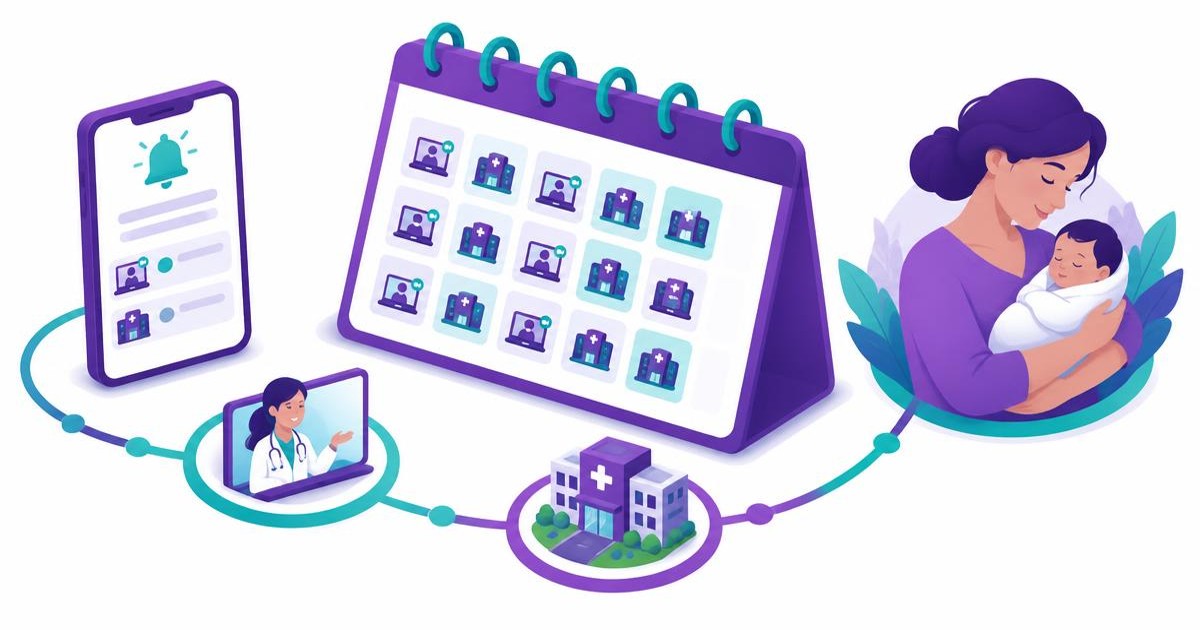
Per the paper: four in-person and four virtual antenatal visits, plus two postpartum visits, one virtual in the first week and one in person at four to six weeks. Virtual visits cover current complaints, fetal movement, education, breastfeeding, mental health screening, and reported blood pressure and glucose. In-person visits cover vital signs, obstetric examination, laboratory work, ultrasound and referral of higher-risk women. The author recommends beginning as a pilot at one clinic with rapid-cycle evaluation of feasibility, acceptability and access, and stresses that telehealth "cannot replace physical attendance at clinics". [HOLD — expert review]
What the platform must handle
- Visit schedule by gestational age, mixing in-person and virtual slots according to the hospital's protocol.
- Arabic and English reminders, with the option for a family member to receive them where the patient agrees.
- Pre-visit questionnaires and self-reported readings (blood pressure, glucose) that reach the clinician before the call.
- Escalation: readings or answers above thresholds set by the clinical team flag the case for same-day review. The thresholds are clinical decisions. [HOLD — expert review]
- Postpartum tracking: the first-week virtual contact, the six-week visit, and a tracked outcome for each (completed, rescheduled, missed).
- Referral flags for high-risk women to the appropriate clinic or hospital.
Virtual antenatal clinic in Saudi Arabia: practical constraints
The paper lists barriers: not every woman has reliable internet, implementation needs space, staff, technology, EMR integration and appointment systems, and satisfaction studies were largely conducted during COVID-19 lockdowns, which may limit how far they apply today. It also cites one study finding that telehealth adversely affected timely use of long-term contraception, so postpartum contraception counselling should have an explicit pathway. Plan phone-call fallbacks for women without a good connection.
Postnatal follow-up: the part hospitals often under-run
After delivery, attention moves to the baby and the discharge date is the last scheduled contact. A platform can create the postpartum schedule at discharge, send a first-week virtual check-in, and flag women who have not attended by the six-week mark for outreach. Mental health screening content in the virtual contact should follow the hospital's own clinical pathway. [HOLD — expert review]
Integration with the hospital system
Hybrid follow-up works only if the data lands in the record. The virtual visit note, readings and referral decisions must be visible to the same clinicians who see the woman in person. See /blog/hospital-patient-app-ehr-integration-saudi-arabia and /blog/nhic-interoperability-multi-branch-hospitals-saudi-arabia. [VERIFY WITH BRAND: CareSync integration scope]
A worked scenario: a two-site maternity service
A hospital runs a maternity clinic at its main campus and a satellite clinic. For low-risk women, the obstetric lead approves a schedule that alternates in-person and virtual visits. The platform books them, sends Arabic reminders, collects blood pressure readings before virtual visits, and flags a woman whose reported reading crosses the lead's threshold for same-day review. At discharge, the platform books the postpartum contacts and lists anyone not seen by six weeks for outreach. The scenario is illustrative and does not describe a CareSync customer outcome.
Pilot plan and measures
Pilot at one site with low-risk pregnancies for one quarter. Measure operational items you control: attendance by visit type, postpartum visit completion, time to review a flagged reading, and patient and clinician satisfaction. Clinical outcomes need expert-designed evaluation. [HOLD — expert review]
Vendor questions
Can the schedule be configured by the hospital's own protocol? Are reminders native Arabic? Can patients submit readings and can thresholds be set per clinic? Does the virtual visit note write into the EMR? How is consent for virtual care recorded? How is data hosted? [VERIFY WITH BRAND]
FAQ
What is hybrid antenatal care?
It is a schedule that mixes in-person visits with virtual ones for low-risk pregnancies. Examinations, labs and ultrasounds stay in person; virtual visits cover education, symptoms and self-reported readings.
Is there a Saudi model for virtual perinatal care?
A 2023 Cureus paper proposes one for Ministry of National Guard primary care, with four in-person and four virtual antenatal visits and two postpartum visits, starting as a one-site pilot. It is a proposal, not outcome data. [HOLD — expert review]
How many antenatal visits does WHO recommend?
The paper cites WHO as recommending at least four visits for low-risk pregnancies, at 12, 20, 28 and 36 weeks. Hospitals follow their own protocol.
Can a platform replace postnatal clinics?
No. It schedules and tracks contacts and flags women who have not attended; the visits themselves remain clinical.
Who decides the escalation thresholds?
The hospital's obstetric and clinical leadership. The platform only applies the rules they set.