Post-Acute Digital Follow-Up: How Egyptian Private Hospitals Can Reduce Readmissions and Build Long-Term Patient Loyalty
Explore structured check-ins, nurse review, medication reconciliation and recovery education for Egyptian private hospitals after discharge.
Clinical safety and scope note: the first 30 days are a common evaluation window, not a universal highest-risk period for every condition. Day 1/3/7/14/30 check-ins and 48–72-hour medication reviews are example schedules requiring clinical approval and risk-based tailoring. Digital escalation is not emergency care, does not guarantee immediate review, and must never delay urgent in-person assessment or emergency services for red-flag symptoms. Channels, pharmacy links and staffing depend on agreed deployment. Readmission, loyalty and revenue benefits are potential, not measured CareSync outcomes; Egypt-wide market assertions are not source-verified here.
Key takeaways
- Explore structured check-ins, nurse review, medication reconciliation and recovery education for Egyptian private hospitals after discharge.
- Deployment scope, clinical protocols, privacy responsibilities and integrations should be agreed with the care team.
On this page
The first thirty days after a patient leaves a hospital following a major acute episode — a cardiac event, an orthopaedic procedure, a surgical intervention — define the long-term trajectory of their recovery. And in Egypt's private hospital sector, this critical window is where most institutions have the weakest clinical presence.
The Egyptian private hospital market is growing and consolidating. Major hospital groups are investing in facility upgrades, new speciality programmes, and in-patient experience improvements. But the post-discharge care pathway — the period between the patient leaving the ward and their first outpatient follow-up — remains structurally thin in most private hospital operations.
The consequences are tangible: avoidable readmissions, clinical deterioration that presents in emergency settings, patient dissatisfaction with the transition of care, and the steady loss of post-acute patients to competing outpatient providers who fill the follow-up gap more actively.
Why Post-Discharge Is the Highest-Risk Window
Clinical evidence consistently identifies the first 30 days post-discharge as the period of highest risk for clinical deterioration and readmission across a range of acute presentations.
The underlying mechanisms are well-understood:
Medication transition failures: Hospital prescribing and community medication availability often differ. Patients discharged on a complex medication regimen — particularly those transitioning from IV to oral therapy, or who have had their chronic disease medications adjusted during admission — frequently encounter difficulties with prescription interpretation, pharmacy access, or medication affordability in the immediate post-discharge period.
Wound and recovery monitoring gaps: For surgical patients, wound status monitoring and early infection detection depend on clinical observation. A patient who would benefit from a wound review on day 5 post-discharge does not get one if the next scheduled appointment is at 2 weeks.
Chronic disease destabilisation post-acute event: A cardiac patient whose diabetes was optimised during admission but whose home dietary and medication adherence patterns have not changed returns to the same glycaemic risk environment they were admitted from. Without structured post-discharge monitoring, this destabilisation is not detected until the next clinic appointment — or the next acute presentation.
Inadequate post-discharge education retention: Patients and families absorb a fraction of discharge education under the stress of leaving hospital. Questions that arise in the first 72 hours post-discharge have no efficient resolution pathway in most Egyptian private hospital settings.
The Operational Gap in Egypt's Private Hospital Sector
Egypt's private hospitals are substantially better resourced than the public sector but operate in a competitive market where post-discharge follow-up has historically depended on:
- The patient proactively following up as instructed
- The referring physician following up by phone (inconsistent and unscalable)
- Scheduled outpatient appointments that may be 2–4 weeks away
In between, the patient manages their recovery with the information they retained from discharge counselling and whatever advice they can access from family or community pharmacy.
For complex chronic disease patients — those admitted with decompensated heart failure, poorly controlled diabetes, or post-surgical complications — this gap is where readmissions originate.
What an Effective Post-Acute Digital Follow-Up Programme Looks Like
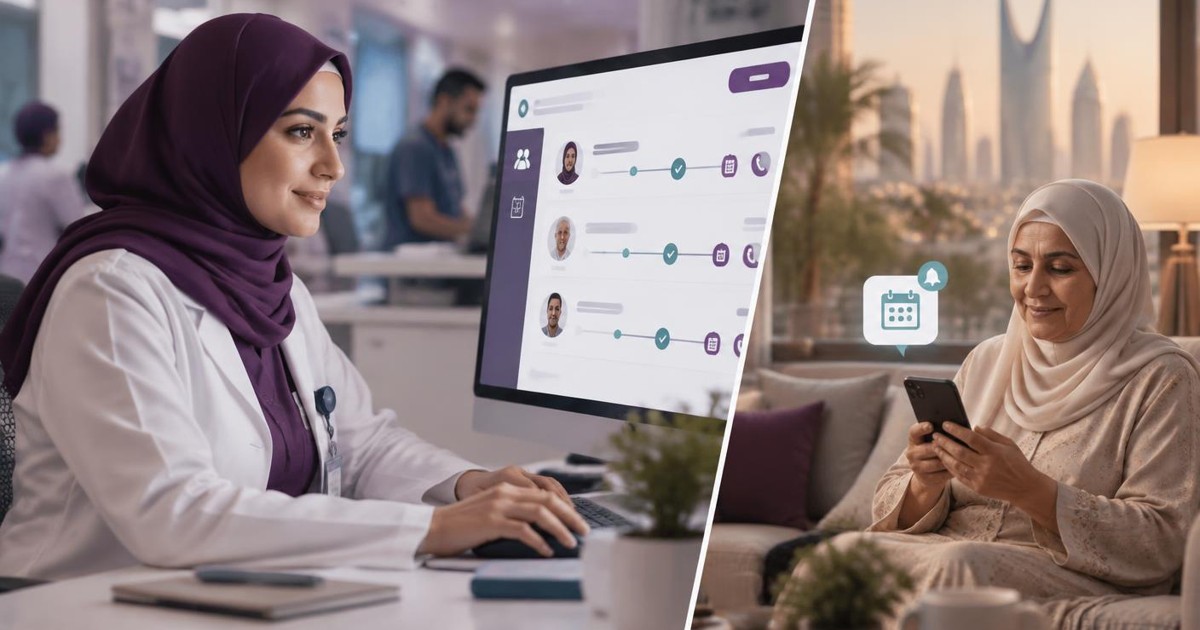
A structured post-acute digital follow-up programme replaces the gap with a clinical touchpoint architecture that extends the hospital's clinical presence into the patient's home recovery period without requiring ward-based clinical staff to manage each patient individually.
Structured day 1/3/7/14/30 digital check-ins: Automated, symptom-based check-in protocols delivered by app, SMS, or WhatsApp that capture key recovery indicators — pain levels, wound status, medication adherence, specific disease-relevant symptoms — at defined intervals. Responses outside protocol parameters trigger clinical review escalation.
Nurse-led remote review calls: For patients in higher-complexity categories, scheduled nurse-led remote review calls at day 3 and day 7 provide direct clinical assessment without requiring a hospital visit for stable patients, while identifying those who need in-person review urgently.
Medication reconciliation support: A structured post-discharge medication review at 48–72 hours — confirming that the patient has accessed their medications, understands the regimen, and can identify any access barriers — prevents the medication failure pathway from opening.
Patient education reinforcement: Condition-specific digital education delivered in modules after discharge — the patient receives relevant content at the right stage of their recovery, rather than all discharge information simultaneously at the point of leaving hospital.
Direct clinical escalation pathway: Patients who report red-flag symptoms through the check-in protocol are escalated immediately to on-call clinical staff, rather than being advised to present to an emergency department.
The Business Case for Egyptian Private Hospitals
Post-acute digital follow-up programmes are not primarily a cost centre. They are a patient experience and loyalty infrastructure:
Readmission reduction: Preventing avoidable readmissions reduces occupancy pressure, improves clinical KPIs, and — for hospitals contracting with corporate health schemes or insurance providers — improves contractual performance metrics.
Patient loyalty: The patient who receives proactive daily check-ins, a nurse call on day three, and a medication review on day two has a fundamentally different perception of the hospital than the patient who left with a two-week appointment and a folder of discharge papers. That experience translates directly to referral behaviour, repeat utilisation, and employer health programme selection.
Specialist outpatient funnel: A patient actively managed by the hospital's digital follow-up programme at day 7 is a patient who schedules their specialist follow-up appointment within the hospital system. The post-acute pathway is a patient retention mechanism for the outpatient programme.
How CareSync Network Enables Post-Acute Follow-Up
CareSync Network's omnichannel patient engagement architecture supports post-acute follow-up programme deployment as a configurable module within the platform's hospital connectivity infrastructure.
Core capabilities include:
- Configurable post-discharge check-in protocols by condition, procedure type, and risk stratification
- Multi-channel patient outreach (SMS, WhatsApp, app) with protocol-driven escalation logic
- Nurse-led remote review scheduling integrated with clinical workflow
- Medication reconciliation tracking connected to pharmacy and discharge prescription records
- Patient education content delivery by condition and recovery stage
- Clinical escalation tracking with audit trail for quality review
Conclusion
Egypt's private hospital sector has invested significantly in clinical capability and facility quality. The missing piece — for patient safety, for readmission reduction, and for long-term patient loyalty — is the structured clinical presence in the post-discharge recovery period.
CareSync Network provides the digital infrastructure to close that gap: extending the hospital's clinical reach into the home recovery environment, keeping patients connected to the care team during the highest-risk window, and building the patient experience that translates into long-term institutional loyalty.
Plan your hospital’s post-discharge pathway
Request a CareSync Network Consultation