Kidney Disease Follow-Up Program for Private Clinics in Egypt: From a Screening Result to a Tracked Patient
Short answer: A kidney disease follow-up program for a private clinic is a registered list of patients with kidney risk or reduced kidney function, a schedule of repeat tests and visits, and a referral route to nephrology. Egypt's national screening includes kidney function tests. Private clinics can add value by turning a single result into a tracked, recalled patient.
Clinical outcome note: any claim that a follow-up program slows kidney disease, prevents dialysis or improves survival is HOLD — expert review.
Key takeaways
- Egypt Today reported on 20 June 2026 that more than 22.15 million citizens had been screened since September 2021 across 3,601 primary healthcare units, with kidney function among the tests (quoting the Health Ministry spokesman).
- The report says patients diagnosed with chronic conditions receive free monthly medication at primary care and complex cases are referred to hospitals at state expense; it gives no count of positive or referred cases.
- A private clinic's operational job: register patients, recall for repeat tests, track referrals, and keep an updated medication list.
- Clinical thresholds, test frequency and referral criteria are for nephrology and the treating doctor. [HOLD — expert review]
On this page
The context: millions screened, follow-up is the weak point
According to the Egypt Today report of 20 June 2026, the national initiative screens adults aged 40 and over, and those 18 and over with risk factors or relevant history, for blood pressure, random and cumulative blood sugar, cholesterol, kidney function and body mass index. It reports 22,154,398 people screened since September 2021 at 3,601 primary healthcare units, and says the programme includes awareness sessions, regular follow-up and training for medical staff following WHO-developed guidelines. The report does not say how many people had abnormal results or were referred. Patients who receive an abnormal result may seek a second opinion or ongoing care from a private clinic, which needs a way to bring them back for repeat testing instead of treating each visit as new.
Who belongs on a kidney register
The treating doctor defines criteria. Typical operational groups include patients with diabetes, hypertension, a family history of kidney disease, an abnormal kidney function result, or prior kidney injury. A register entry holds the date and value of each kidney-related test, current medicines, the doctor's follow-up interval, and next due date. [HOLD — expert review: inclusion criteria, test frequency and thresholds]
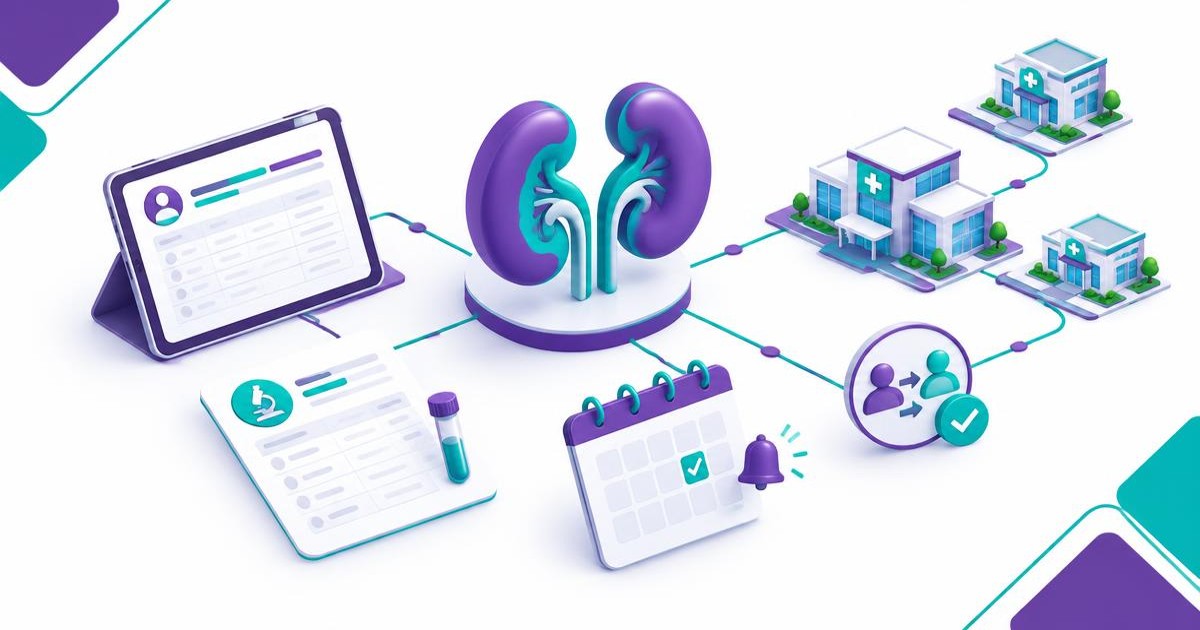
The five-part follow-up workflow
- Register: add the patient with consent, source of the result (national screening, other lab, clinic test) and the document attached.
- Schedule: the doctor sets the repeat test and visit interval; the system creates due dates.
- Recall: reminders in Arabic by WhatsApp or SMS before due dates, and a recall list for overdue patients. See /egypt/blog/whatsapp-appointment-reminders-egypt-clinics-no-show.
- Refer: for patients the doctor refers to a nephrologist or hospital, track whether the appointment occurred and whether a report returned.
- Review: a monthly view for the clinical lead of patients overdue, referred but not seen, and with missing tests.
Chronic kidney disease patient register for a clinic in Egypt: data fields
Patient identifier, date of birth, conditions, test name, date and value (as reported by the lab), medicines, next due date, referral status, consent status and preferred contact. Keep lab results in structured fields so trends are visible. See /egypt/blog/lab-radiology-integration-egypt-clinics-digital.
Linking with the medicines question
Patients with kidney risk often take several long-term medicines, and the doctor may need to review medicines when results change. The clinic's role is to ensure the current medicine list is in the record, to flag overdue tests before refills, and to avoid giving dosing advice through messages. [HOLD — expert review] See /egypt/blog/pharmacy-clinic-integration-chronic-disease-egypt.
Working alongside the public system
The national programme reportedly provides free monthly medication for diagnosed chronic patients at primary care and refers cases for specialised care at state expense. Private clinics should not assume patients' public and private records are linked. Ask patients to bring results and medication lists, record the source, and respect each patient's choice of where to receive care. [VERIFY WITH BRAND: any integration with national systems]
A worked scenario: a four-branch clinic group in the Delta and Cairo
A group registers patients with diabetes or hypertension who have had a kidney function test recorded. The lead physician sets repeat-test intervals by risk group. Reception sends Arabic reminders two weeks before the due date and calls those who have not booked. A nurse tracks referrals to nephrology and records when a report returns. The monthly review lists overdue and unreferred patients. The scenario is illustrative, not CareSync customer data.
Staff roles and privacy
Assign a register owner, a recall owner and a referral owner. Kidney results are health data under Egypt's Personal Data Protection Law (Law 151 of 2020): use consent, role-based access and limited message content. See /egypt/blog/patient-data-privacy-egypt-law-151-clinics. [VERIFY WITH BRAND]
Measures to track
Share of registered patients with a test in the interval the doctor set; share of referred patients with a completed visit; and recall response rate. Avoid outcome claims without clinical evaluation. [HOLD — expert review]
FAQ
Does Egypt's national screening include kidney function?
Egypt Today (20 June 2026), quoting the Health Ministry spokesman, lists kidney function among the tests in the national chronic and kidney disease screening initiative.
How many people have been screened?
The same report states 22,154,398 people since September 2021, across 3,601 primary healthcare units. It does not give how many had abnormal results.
Who decides how often to repeat kidney tests?
The treating doctor or nephrologist. The clinic's system applies the interval the doctor sets and sends the reminders.
Can a clinic use WhatsApp for reminders?
Yes, with patient consent and without including results or dosing advice in messages. Follow Law 151 of 2020. [VERIFY WITH BRAND]
Do we need software for a kidney register?
A spreadsheet can start a small register. Software helps when branches, recalls and referrals multiply and when you need a reliable audit trail.